Jorge Borges
 Madeiran, pianist, Jazz singer, and also arranger and composer, Helder Martins was - and still is – fairly unknown by his countrymen, but was a prominent figure of Portuguese music of the fifties and sixties, in the area of Jazz, but also - in the imperative of survival, certainly - in light music. Abandoning a course on Engineering to focus exclusively on a successful musical career, particularly in Lisbon where he moved to still very young, but also in Mozambique and Rhodesia and especially in South Africa, where he reached high levels of notoriety. Since childhood, it was clearly visible the natural ability of Helder on the piano, as accounted by his old childhood friend John Pestana in a testimony published in the programme of “VI Funchal Jazz”: "Where there was a piano, as in 'Ritz Cafe', in the city centre, there he was exercising his musical gifts." Basically self taught, Helder Martins became an excellent pianist, as a soloist or accompanist evolving from Swing to Bebop. Unfortunately, the discography of Helder Martins, who recorded dozens of records, is practically all influenced by the popular rhythms of that time, such as boleros, mambos, sambas, cha-cha-chas, and later, rock and roll, twist, YE-yes, it is very rare to find traces of his mastery as an improviser. Except for two brief and tasteful solos in the songs "Vocês Sabem Lá" and "Terra Formosa", from the album "Uma noite na Canoa II". A very attentive and informed musician, restless spirit, studious, always in search of being up to date, Helder Martins signed excellent arrangements for small and medium formations in all kinds of Musical genres, and also inspired by great masters such as Duke Ellington, from the Big Band Jazz. It is important to highlight in this context the original arrangements of themes such as "How High The Moon"," 'C' Jam Blues" or "Take The 'A' Train", that were revisited live in an appropriate and impeccable interpretation by Big Band of the “Hot Clube de Portugal”, during the tribute that the Funchal Jazz Festival provided in its 2005 edition. Not surprising therefore that his namesake Helder Bruno Martins, devotes six entries in the book "Jazz in Portugal (1920-1956)". In
 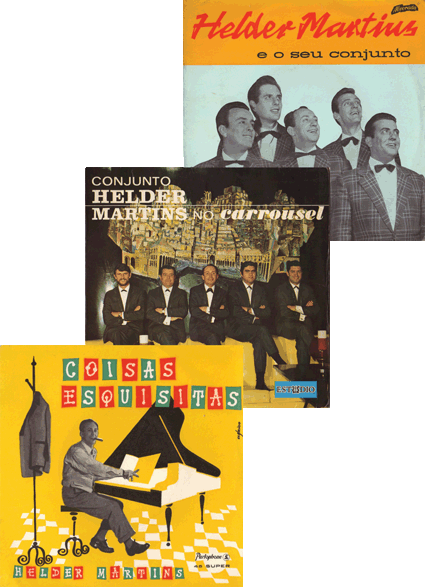 fact, in addition to his facet as a great animator of the Lisbon night with his 'Set' as a professional musician, in restaurants and clubs as the "Canoa", "Carroussel", "Casa da Madeira" or the Casino Estoril, Helder Martins plays an important part in the history of Jazz made in Portugal and, in particular, in the history of the 'Hot Clube de Portugal' arguably its most representative establishment. Luiz Villas-Boas, undisputed patron of Jazz in Portugal, reveals that H. Martins, as a musician, "was made in Hot Clube", where he played assiduously in Jam-Sessions. And from Bernardo Moreira (father), now President of the “Hot”, comes the recognition that Helder was part of the group of musicians who "were the first in Portugal with ears open for Jazz". In the middle fifties, Martins was the pianist of “'Quinteto do Hot” and participated, together with two other Madeiran, namely, the guitarist Carlos Menezes and the singer Max, also pioneers of jazz in Portugal, in I(1953), II(1954), III(1955) and IV(1958) Festivals of Modern Music (Jazz), organized by 'Hot Club'. As a composer, the work he has left is of great merit and advanced music design, as shown by the rich harmony of “Tinny's Bop Blues” the multi-stylistic and unpredictable “African Blues” or the seductive melody of 'Thousand Stars', of exemplary construction.

